About Golconda Fort
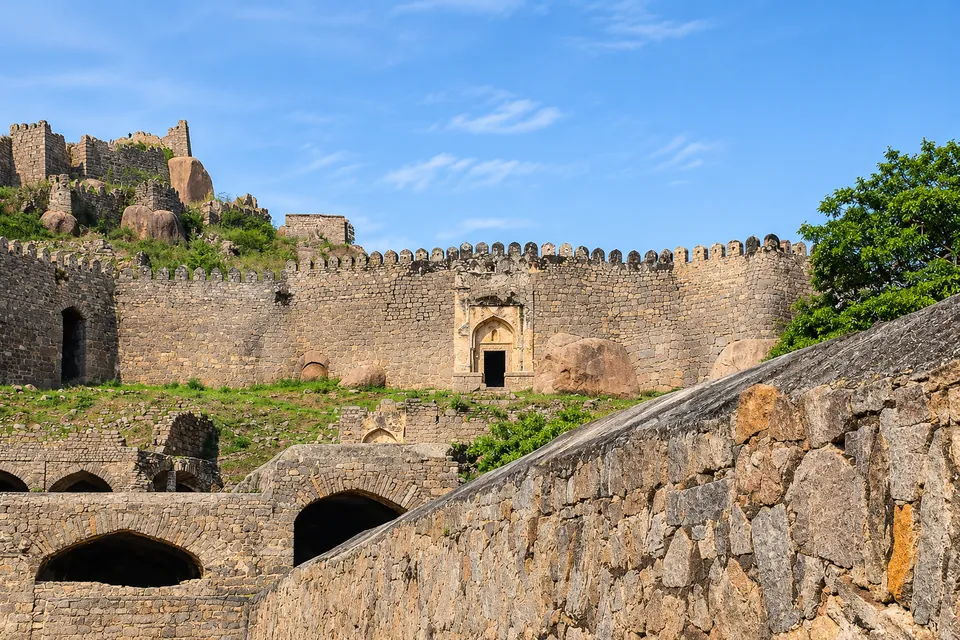
Golconda Fort is the great granite citadel on the western edge of Hyderabad, and the place the city’s story begins. Before Hyderabad existed, this hilltop was the seat of the Qutb Shahi sultans, and its walls, gateways and palaces still climb the hill in tiers to a pavilion at the summit.
For most visitors it is the high point of a Hyderabad trip, in both senses. The walk up from the main gate passes mosques, a temple, granaries and ruined halls, and ends with a view across the old fort walls to the domes of the Qutb Shahi Tombs and the modern city beyond.
History
The site was fortified long before the Qutb Shahs. It began as a mud fort under the Kakatiya kings of Warangal, and passed to the Bahmani Sultanate in the fourteenth century.
Around 1501 the Bahmanis sent Quli Qutb Mulk to govern the region from Golconda. In 1518 he broke away and made the fort the capital of his own kingdom, the Golconda Sultanate. He and the next two sultans spent some sixty years turning the mud fort into the granite stronghold seen today — four forts in one, with 87 bastions and eight gateways. The court moved to the new city of Hyderabad in 1590, but Golconda remained its fortress.
Golconda was also a diamond town. Stones from the Kollur mine on the Krishna river were traded here, and some of the most famous diamonds in history, including the Koh-i-Noor and the Hope, are linked to Golconda. The kingdom ended in 1687, when the Mughal emperor Aurangzeb took the fort after a siege of about eight months and captured the last sultan, Abul Hasan Qutb Shah.
What to see and do
- Fateh Darwaza, the lower “victory gate”, studded with iron spikes against war elephants.
- The clap under the dome at the Fateh Darwaza entrance, which carries up to the Bala Hisar pavilion at the summit, nearly a kilometre away — once an early warning of attack.
- The climb to the Bala Hisar pavilion at the top, with the widest views over the fort and the city.
- The Jagadamba temple near the summit, which draws large crowds during the Bonalu festival, and the Ibrahim mosque beside it.
- Ramadas Bandikhana, the cell where the saint-poet Bhakta Ramadas is said to have been held, and the ruins of the royal quarters and durbar hall.
- Taramati mosque, the Nagina Bagh garden, and the old armoury and granary buildings.
- The evening sound and light show, which tells the fort’s story with the walls as the backdrop.
Getting there
Golconda is in western Hyderabad, roughly 10 km from the Charminar. By car or cab it takes about 30 minutes to an hour depending on traffic; the drive is usually combined with the Qutb Shahi Tombs, which stand just north of the fort’s outer wall.
Tips for your visit
- Wear comfortable shoes. The path to the top is a long climb on uneven stone steps with little shade.
- Carry water and go in the afternoon rather than at midday, especially from April to June.
- Pair it with the Qutb Shahi Tombs next door and stay for the evening show to make a half day of it.
- A local guide brings the ruins to life, and shows you where to stand for the clapping trick.
- Timings, entry fees and show languages change. We confirm them when we plan your trip.
Golconda Fort: common questions
Sources
Facts checked against these sources. Timings and entry fees change; we confirm them when we plan your trip.