About Chinese Fishing Nets
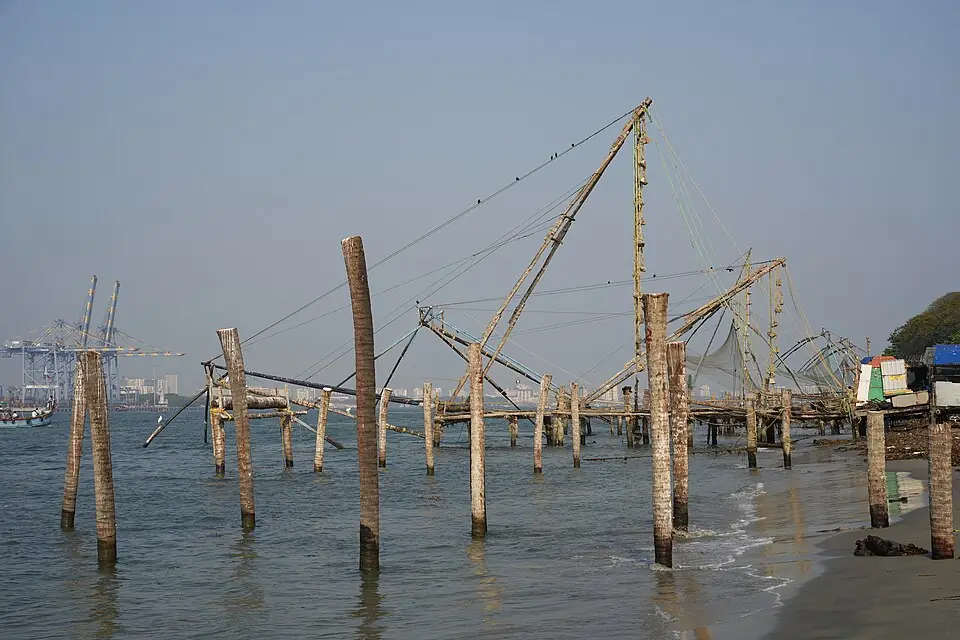
The giant fishing nets along the Fort Kochi waterfront are the city’s best-known sight. Each is a great cantilever of timber, at least 10 m high, with a wide net hung over the water at one end and a row of heavy stones on ropes at the other as counterweights.
A team of fishermen works each one, walking along the main beam to lower the net into the water, waiting a few minutes, and then hauling on the ropes to lift it again. The catch is modest — a few fish and prawns — and is often sold straight away to passers-by, and stalls nearby will cook it for you.
History
Nets of this kind are used along the coasts of southern China and Southeast Asia, and in India are found mostly at Kochi and Kollam. They are said to have been introduced by Chinese traders and explorers in the fourteenth century, possibly in the time of Zheng He’s voyages. Their formal name is shore-operated lift nets; in Malayalam they are cheena vala.
What to see and do
- Watching a team raise and lower a net.
- Sunset behind the nets over the harbour mouth.
- Fresh fish from the catch, cooked at stalls nearby.
- Ships passing in and out of Kochi harbour.
Getting there
The nets stand along the waterfront at Fort Kochi, near Vasco da Gama Square and a short walk from St Francis Church.
Tips for your visit
- Fishermen sometimes let visitors try the net, and may ask for a tip.
- Agree the price before having fish cooked at the stalls.
- Come back at sunset; the light is best for photographs then.
Chinese Fishing Nets: common questions
Sources
Facts checked against these sources. Timings and entry fees change; we confirm them when we plan your trip.